
9 Minute Read | Contributor: Chris Angelatos
Last year, we closed two investments in HealthTech, Tendo and Glooko, building off historical momentum from our prior investments in meQuilibrium and VALD. We are taking more intentional steps and seeking to deploy greater capital into the HealthTech sector, where Chris Angelatos, Director, leads efforts for us.
Why HealthTech, and why now? It is a sector with an immense and growing opportunity set. There are a range of durable, long-term tailwinds and structural advantages to the space that are evergreen. And like everywhere else, AI is having an accelerating impact, but we feel this creates more advantages than threats for many companies in the space.
We will elaborate on several key themes:
- There is a massive TAM available with meaningful whitespace, and rampant growth in healthcare spending makes this an urgent problem.
- Regulatory tailwinds are driving additional step changes in the adoption of technology.
- The rise of value-based care and employer-sponsored healthcare are driving structural changes in how healthcare is funded and delivered.
- AI is well suited to solve the manual, text-based administrative workflows that are holding healthcare back.
- Vistara’s flexible growth capital solutions are uniquely suited to help companies capitalize on these trends and allow ambitious founders to own more of the upside they create.
Read on for our investment thesis in HealthTech.
Meaningful Regulatory Tailwinds Driving Investment and Adoption
- Regulatory tailwinds from the HITECH Act (bringing EMR adoption to near-100%) and the Patient Protection and Affordable Care Act (expanding Medicare/Medicaid and supporting innovative care delivery methods to lower costs of care) essentially sparked the creation of HealthTech as a category in 2010, and regulatory changes during COVID 10x’d adoption of digital health.
- Very importantly, AI is now becoming the de facto digital front door to healthcare and is driving a massive increase in consumer engagement, with 1 in 3 individuals using AI chatbots for health information (Rock Health).
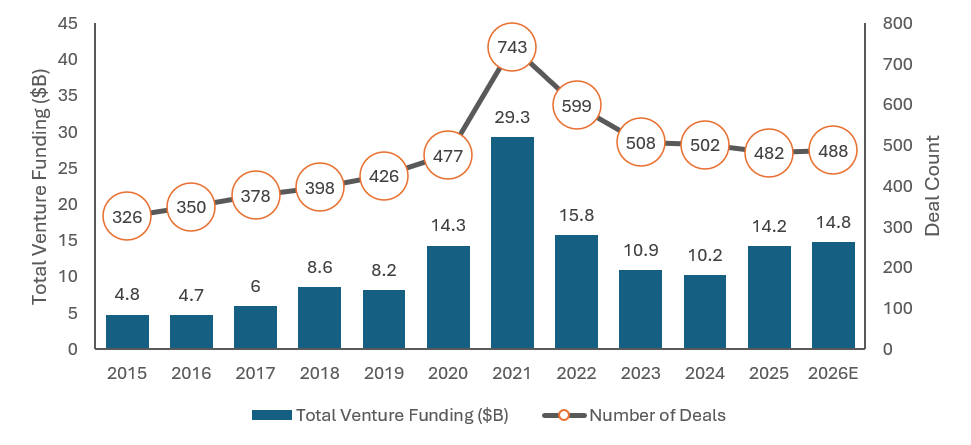
- Funding has also exploded with annual venture dollars invested in the sector growing by nearly 3x over the past ten years, roaring out of the gates in 2026 with Q1 as the largest quarter since the pandemic and AI interest driving continued momentum into Q2 (Rock Health).
- As a result of this accelerating funding cadence, PitchBook now tracks nearly 20,000 HealthTech companies in North America – with certainly more than enough that meet our investment criteria.
Massive TAM & Digitization Whitespace, with AI Growing Both Vectors
- Healthcare accounts for 20% of US GDP and annual spending has reached $5.3T, growing to $9T by 2034 (CMS), with ~11% of people employed in the US working in the healthcare sector (Peterson-KFF).
- While accounting for 20% of GDP, healthcare only accounts for 12% of software spend, indicating digital transformation is relatively early. This is trending up with the sector deploying AI at 2.2x the rate of the broader economy (Menlo Ventures).
- Today, approximately 75% of healthcare expenditure is the cost of care delivery. This truly enormous TAM is directly addressable by tech-enabled clinical services platforms, especially those integrating AI to drive efficiency and gross margin improvements.
- 25% of healthcare spend, still a massive ~$1.3T, is administrative spending that is addressable by software. The current healthcare IT spend of $167B barely scratches the surface (Grand View Research), leaving >$1T in untapped opportunity.
- Relative to these numbers, healthcare AI was estimated to have “only” captured $1.4B in 2025. After existing IT spend, healthcare AI can continue to automate manual workflows that were never part of IT budgets (e.g., prior authorization, patient engagement, etc.), converting services dollars into tech dollars and opening up over a trillion dollars in market opportunity.
Rise of Value-Based Care Models
- CMS has set a goal for all Medicare beneficiaries to be in a care relationship with a provider who has accountability for quality and total cost of care by 2030 (CMS).
- While the goal will likely not be fully met on schedule, it is directionally intact and the shift from pay-for-activity to pay-for-performance is driving a seismic need for innovation across the industry.
- Providers need to be able to deliver care better, faster, and cheaper while maintaining high quality standards, which necessitates investment in technology.
Shift to Self-Funded Employer Healthcare Creating a New Customer Segment
- Self-funded plans involve employers assuming all financial risk for providing healthcare benefits to employees, rather than paying a fixed premium to a health insurance carrier for employee medical expenses. This allows for more flexibility and potentially cost savings, but carries financial risk and administrative burden.
- This created and is driving the “Employer” customer segment for HealthTech companies and opens up the clinical services TAM dramatically. For companies that can improve outcomes and lower costs in key therapeutic areas, there is immense value to be created.
Ongoing Health System Margin Compression
- Higher costs, lower revenue – a CFO’s worst nightmare. Health systems were hit hard by the pandemic, with median operating margins plummeting to -5.3% in 2020 (Definitive Healthcare).
- While margins have somewhat recovered and stabilized across the industry from COVID-related shocks, reaching 1% to 1.3% in 2025 (Strata), reimbursement rates haven’t kept up with inflationary pressures and margin pressure will continue to persist.
- In the face of this, hospitals are increasingly turning to technology and data analytics, site of care shifts, and other value-based improvements, driving spending on technology to improve margins.
Emergence of AI
- A proliferation of painful, bureaucratic processes is driving the >$1T in healthcare admin spend and these are largely text-based and manual tasks completed by humans. Growth in overall technology adoption across healthcare has gone hand in hand with increased administrative and documentation burden, exacerbating healthcare provider burnout issues and lowering quality of care.
- The combination of text-based workflows, novel text-based AI and voice models well suited to automate those workflows, and a critically important and expensive problem to solve creates a series of compelling growth opportunities at the application layer (e.g., ambient scribes, revenue cycle automation) and at the infrastructure layer (e.g., interoperability, data quality).
The combination of regulatory tailwinds and a massive and inefficient market has led to consistent and growing investment interest in HealthTech. There is also a proliferation of manual, administrative processes requiring massive spend that are ripe for AI disruption. However, this isn’t a market where you can “vibe code” something in a weekend – healthcare buyers rely heavily on trust and vendors must deeply understand a complex regulatory environment along with data privacy and data security requirements, which favours vertical focused vendors that have proprietary data access, trust, and domain expertise.
Where Vistara Fits
We have the unique ability to provide Growth Debt, Growth Equity, or any combination, enabling us to match the right form of capital to the situation a company is facing and maximize growth while limiting dilution. Healthcare is characterized by long sales cycles, massive but years-long tailwinds, and a regulatory landscape that complicates the use of AI. Our capital can act as “rental equity”, enabling companies to capitalize on these slower moving, but more rewarding, trends, and access growth capital without having to price equity or incur dilution until key proof points are achieved.
We’re looking across HealthTech subsectors and are eager to expand our portfolio, not only for the stellar investment opportunities but also to play a meaningful part in lowering costs and improving the quality of healthcare across North America.
If you’d like to connect to discuss our interest and activity in HealthTech, please reach out to Chris.
Looking for Flexible Growth Capital?
Read our case studies to learn how our growth debt and equity solutions have enabled our founders and helped our portfolio companies.